

Veterinary visits have dropped and are below pre-COVID levels. Vetcelerator has been tracking this trend, and we have prepared a real-world look at what delaying care entails and how to reframe the approach to retaining and re-engaging lapsing patients at your veterinary practice.
Declining Visits to the Vet Are in the Data
The AVMA has published helpful data points for practice owners looking to understand financial projections using the average visits per patient per year. Historically, the numbers were remarkably stable.
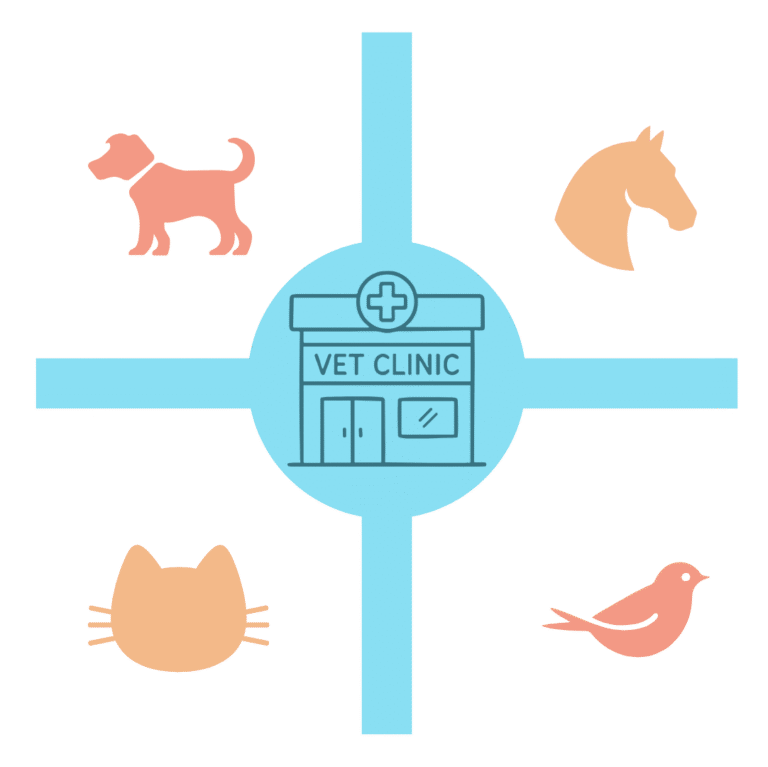
In fact, in the AVMA’s 2017–18 Pet Ownership and Demographics Sourcebook, covering 2016, the report indicated that visit rates had remained fairly stable for a decade or longer:
- 1.5 times per dog
- 0.7 times per cat
- 0.1 times per bird
- 0.7 times per horse
This was their last time using this metric. This data point has moved to visits per owner, which is, frankly, less useful for this particular analysis because a veterinarian examines the patient, not the owner.
Rates are no longer stable. There’s been plenty of coverage (Vetsource, CATalyst Council, and Veterinary Practice News, just to name a few) on the decline in veterinary visits. In addition to broader industry reports, Jon Ayers continues to populate LinkedIn with expert analysis, and the Fountain Report highlights weekly the cost of veterinary care and the affordability challenges facing middle-class pet owners. In this article, we are specifically looking at lapsing patients.
What Does a Veterinary Lapsing Patient Actually Look Like?
Every veterinary practice has an approach to retention, and most have a definition for lapsing patients, with a separate workflow for getting a lapsing patient back into the practice.
These definitions are not universal: some say a patient lapses after 12 months, others 13 months, and others wait until 18 months to change the workflow. Some practices use text, email, (sometimes) phone calls, and (less often) offers to bring a patient’s owner back. But very few veterinary practice owners are considering a retention marketing budget.

When thinking about lapsing care, retention, and visits per patient, let’s examine a real-life example. The following data was unfortunately taken from a practice Vetcelerator worked with that unexpectedly closed, and we helped process their records requests so they could move on.
The chart below shows the number of records requests processed by month. It totals 530 requests over roughly 18 months. As you can see, requests are still (!) coming in as of this September.
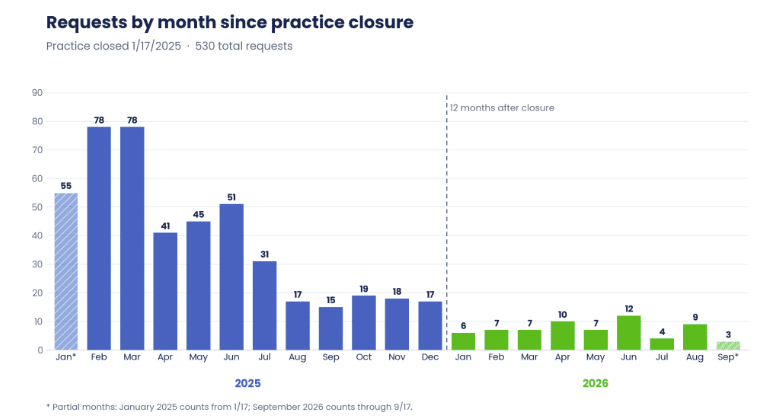
To be sure, this practice had more than 530 patients, so the requests don’t include all the owners who simply moved on without records, nor does it include those who haven’t asked for records yet. This chart illustrates an important point: definitions of lapsing patients and retention, as well as workflows, will need to change as a portion of the customer base delays care.
This practice closed on January 17, 2025. Well over a year later, requests for records continue to occur, albeit at a slower pace. For example, the 18 requests for records in November of 2025 were for patients seen sometime before January 2025. They could have been seen in November 2024, or far before that date. Moreover, the 12 clients that wanted records in June 2026 also hadn’t been seen since before January 2025, a full 18 months earlier at least.
Two Lessons About Lapsing Patients
Lesson 1: Support and Retain Your Current Client Base
Is the pet owner really lapsing on bringing their pet in, or have they moved their pet’s care elsewhere? The truth is that they may just be delaying it, so veterinary practices need to think about how they are protecting visits.

The first way may be simply to encourage a client at the time of discharge to book their pet’s next appointment.
Of course, “forward booking” is the term for this, but consider supplementing that with an incentive, e.g., $10 off an exam to customers who book at discharge, or you could incorporate a wellness plan to increase the framework for care.

The strategy needs to be to increase purchase consideration. Think of purchase consideration this way:
- When does someone think about your veterinary clinic, and how can you increase the amount of times they do?
- Which partners in your hyper-local space can help you with that increase, and how can you be available mentally to those in your local market?
Giving people more ways to think about you is almost always a good idea. We’ve shared more ideas on competition and purchase consideration here.

Finally, once you’ve increased purchase consideration, don’t waste your client’s time. Answer their questions up front, including:
When can I get an appointment? (examples: multiple ways to schedule, calling them instead of waiting for them to call you, revisiting the reminder system you established in 2019)
How much will it cost? (think: common priced items listed on your website, clear financing options for those that need an off-ramp, and plan offerings to support a care framework)
Lesson 2: You Need New Client Acquisition
Ask yourself, if pet owners are delaying care and visits are down, then how is my veterinary practice going to backfill those appointments? As we wrote last month: “If nobody wants to see your movie, there’s nothing you can do to stop them.” Uninterested pet owners aren’t going to make an appointment. You need to reach the ones that are interested.
How many new customers do you need? Let’s look at the data points referenced above, retention, and patients per visit per year to figure it out. Here we are defining retention as customers that will visit you again, with the inverse of this number being those that have completely churned and not just delaying care.
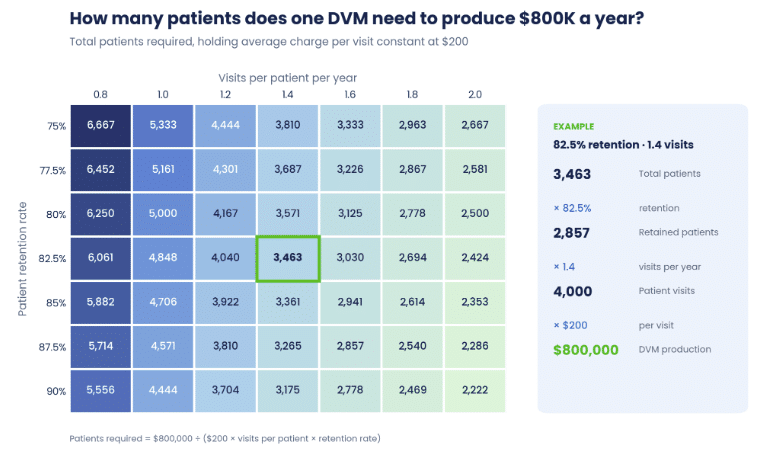
You can see above that a practice with 3,463 customers that has an average patient visit of 1.4x per year and retains 82.5% of their customers can generate $800,000 for a single DVM at $200 Average Patient Transaction. These are general numbers and don’t include revenue from the online pharmacy, etc.
What happens when patient visits drop to 1.2x per year, or even 1x per year, on average, holding everything else constant? The number of patients gets much, much larger. Now, a practice needs to have 700-1400 new patients, whether from additional pets through existing clients or net new clients. Where are those new clients coming from, and how are you reaching them?
Our Advice is Increase Acquisition and Retention Together
Veterinary clinics should review their Paid, Owned, and Earned media strategy to drive net new customer acquisition, in addition to defending against patient retention and care lapses. Within each category, there is a solution. Instead of picking one channel, understand how each one contributes to keeping your practice visible and relevant to the people you serve.
Paid Media: Reach Local Pet Owners Actively Looking for Care
Digital advertising through Google and Meta can put your practice in front of people in your market who are searching for veterinary services or are likely to need them. Read more about conversion-focused veterinary advertising here.
Owned Media: Make it Easy to Choose and Contact Your Practice

Your website should answer the questions that matter most to a prospective client and make the next step clear. Think services, scheduling, pricing information where appropriate, financing options, and a straightforward path to booking. Read more about removing friction from veterinary websites here.
Earned Media: Grow Visibility Within Your Local Community

Community relationships, online reviews, and local conversations keep a clinic visible outside of traditional advertising. Consider options like Reddit AMAs and partnerships with other local businesses.
Have a Strategy for Getting the Next Appointment Booked
Every business problem is a marketing problem. Declining visit frequency is a good example. It touches retention, pricing, communication, digital presence, local awareness, scheduling, and new client acquisition. Practices that understand those connections can make informed decisions about where their next appointment will come from and build the strategy to generate it.
If you’re looking to create a strategy at your veterinary practice that keeps lapsing patients engaged and increases new clients, reach out to us at Vetcelerator. We’ll make one together.