

AI veterinary marketing is already changing how pet owners find a clinic, decide who to trust, and choose where to book. The biggest shift is that discovery is moving toward direct answers (AI summaries, voice tools, chat experiences) and automated ad delivery that rewards practices with clean tracking and strong data inputs.
Independent practice owners need the right visibility fundamentals so AI can understand your clinic, recommend you with confidence, and send prospects to a frictionless booking path.
What Changed: Fewer Clicks, Faster Decisions
Today, many searches resolve sooner because people can get a “good enough” answer directly in the search experience. That means your Google presence, service pages, and trust signals matter more than ever, because pet owners may decide before they browse multiple sites.
At the same time, advertising platforms are leaning deeper into AI-driven optimization. The upside is major efficiency, but only if your conversions are tracked correctly and reflect real business outcomes.
The Two Growth Goals That Still Matter
No matter how AI evolves, clinic growth still boils down to two goals:

Create demand (visibility):
Be easy to find in your local market

Close demand (conversion):
Turn interest into calls, forms, and booked appointments.
AI changes how those happen, but not what you are trying to accomplish.
How AI Changes Local Search For Veterinary Clinics
When someone searches:
- “vet near me”
- “emergency vet open now”
- “dog dental cleaning cost”
- “cat not eating what to do”
AI is increasingly influencing which clinics are surfaced, summarized, and trusted quickly.
SEO Vs GEO Vs AEO
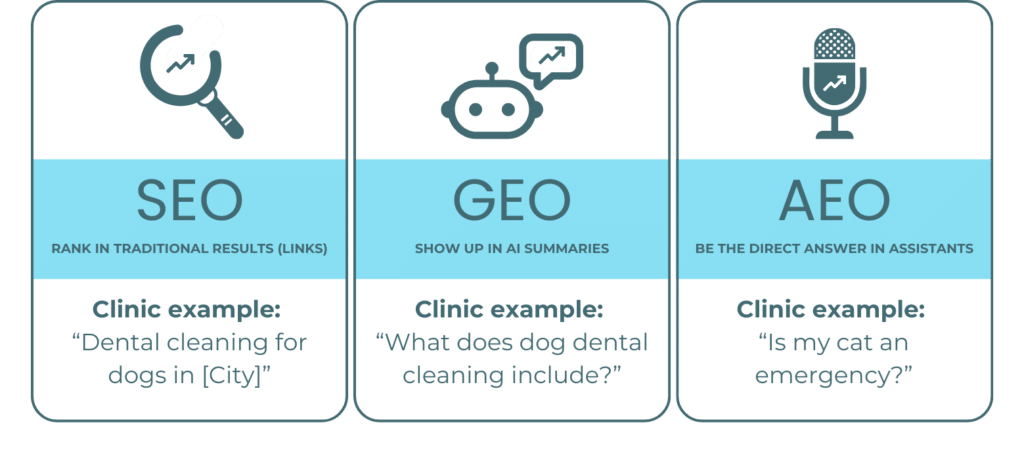
SEO (Search Engine Optimization)
Helps your website rank in traditional search results (the blue links).
GEO (Generative Engine Optimization)
Helps your content appear inside AI-generated summaries and overviews (the “answer style” experience)
AEO (Answer Engine Optimization)
Helps your content get selected as the direct answer in assistants, voice searches, and chat-based tools.
The shift is not that search is disappearing; it’s that fewer people are clicking around. Pet owners are getting what they need directly from the results page, which makes your owned media, your website, your Google presence, and your credibility signals more important than ever.
The Clinic Content Upgrades That Help AI Recommend You
AI summaries are triggered heavily by longer, question-based searches. That is good news for independent clinics, because you can build content around the exact questions pet owners ask.
1) Build Service Pages For Local Intent (Not Generic Copy)
Instead of one “Services” page with a list, create dedicated pages for your highest-demand services, such as:
- Urgent care or same-day appointments
- Wellness exams
- Dental care
- Spay and neuter
- Senior pet care
- Allergy or dermatology
- Surgery (if applicable)
Each service page should clearly answer:
- Who it is for
- What happens during the visit
- What affects cost (ranges are fine)
- When to call ASAP
2) Use Question-Style Headings And Answer Immediately
Use headings that match real searches, for example:
- “How Much Does A Dog Dental Cleaning Cost?”
- “How Do I Know If My Cat Needs Urgent Care?”
- “Do You Offer Same-Day Appointments?”
Then answer in 1 to 3 sentences directly under the heading, before adding details. This structure helps both humans and AI.
3) Add An FAQ Block To Every Core Service Page
Aim for 5 to 8 FAQs per service page. Include:
- Pricing expectations (“What affects the cost?”)
- Timing recognizes (“How long does it take?”)
- Prep (“Should my pet fast?”)
- Next steps (“How do I book?”)
4) Strengthen Trust Signals Everywhere
Both AI systems and humans look for credibility. Make sure these are easy to find:
- Doctor bios and credentials
- Clinic policies (payments, cancellations, emergencies)
- Review volume and recent reviews
- Clear phone number and location
- Photos of the practice and team
If your pages feel vague, AI has less to “grab” with confidence.
Dig deeper into optimizing your website by structure and content.
What We Are Seeing: AI Referrals Are Already Real
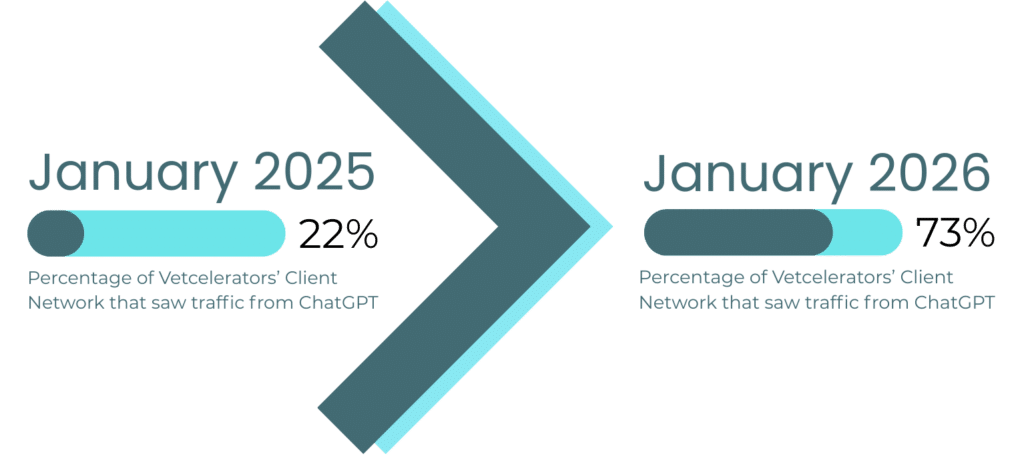
Across the Vetcelerator clinic network, we observed a 1,278% increase in users arriving via ChatGPT referrals from January 2025 to January 2026. Over the same period, the share of accounts receiving any ChatGPT-attributed traffic grew from 22% to 73%.
Translation: AI discovery is no longer niche. It is becoming a standard part of how pet owners find clinics.
AI For Advertising: Automation Only Works With Clean Inputs
Modern ad platforms use machine learning to help decide:
- Who to show ads to
- Which queries match
- Which creative assets to serve
- When to bid more aggressively
The opportunity is big, but automation only performs well when you feed it clean, accurate signals.
The Two Inputs That Make Or Break Performance
1) Conversion Tracking (The “What Happened?” Signal)
Track high-intent actions like:
- Phone calls (especially qualified calls)
- Appointment requests
- Online booking clicks
- Form submission
2) First-Party Performance Data (The “What Mattered?” Signal)
Understand what your best patients do before booking:
- Which pages they view
- Which services convert
- How long it takes to book
- Which channels drive the best cases
Do Not Treat All Leads The Same
A general question is not the same as:
- Surgery inquiry
- Urgent care call
- Dental booking
- New client appointment request
When your tracking distinguishes high-value actions from low-intent actions, ad automation can prioritize the outcomes that matter most.
The AI-Readiness Checklist For Independent Veterinary Practices
Use this to quickly spot your biggest gaps.

Local Discovery (Visibility)
- Google Business Profile is complete, current, and actively reviewed
- Primary services have dedicated pages on your site
- Each service page has FAQs and clear “next steps.”
- Your NAP (name, address, phone) is consistent everywhere

Trust (Credibility)
- Doctor and team bios are easy to find
- Recent reviews are visible and replied to
- Policies and pricing expectations are clearly explained

Conversion (Booking)
- Phone number is clickable on mobile
- Online booking is prominent (if offered)
- Forms are short and route correctly
- Calls and form leads are measured accurately
Advertising (Efficiency)
- Conversion tracking is verified end-to-end
- Key conversions have values or priorities
- Landing pages match the service being advertised
- Call tracking is set up so you know what is working
How Vetcelerator Helps
AI is changing how pet owners choose a veterinarian, but the playbook is still familiar:
Be easy to find, be trusted quickly, make booking simple.
Vetcelerator helps clinics show up across the full decision path:
Website Content → Local Visibility → Social Media → Paid Media → Call Tracking
We stay current on discovery behavior, ad platform changes, and attribution so independent clinics can compete locally and turn attention into booked appointments.
Ready To See Where Your Clinic Stands?
If you want to strengthen your clinic’s AI readiness across search and advertising, we will identify gaps, improve tracking, and build a plan to support local growth. Get started with a Free Audit Today.
FAQs
We answer your
Veterinary AI Marketing Questions.
AI for veterinary marketing uses artificial intelligence tools to automate and improve client acquisition, retention, communication, and advertising for veterinary clinics.
No. AI reduces repetitive administrative tasks so your team can focus on higher-value client interactions.
Many clinics see measurable improvements in appointment bookings and retention within 60–90 days when AI is implemented strategically.
AI search engines prioritize clear, structured, and authoritative content. That means your website should directly answer common pet owner questions, use well-organized headings, and clearly define services. Pages should be written in a way that mirrors how people actually ask questions, while reinforcing your location and expertise.
AI systems favor concise explanations, strong service descriptions, FAQs, and educational content that directly addresses intent. Pages that clearly explain procedures, pricing considerations, preventive care, and next steps are more likely to be surfaced in AI-generated responses. Depth matters, but clarity matters more.
Yes—local relevance is critical. AI search tools prioritize proximity and geographic signals when recommending service providers. Your website should consistently reference your city, service area, and community involvement across key pages. Clear location markers help AI systems confidently associate your clinic with local pet owner searches.
Structure is foundational. Proper heading hierarchy, internal linking between related services, fast load times, and mobile optimization all help AI systems understand and reference your content. A technically sound site gives your content the credibility and clarity required to be cited in AI-generated summaries.
The core principle is the same: answer real questions with authority. However, AI search favors conversational phrasing, clearly defined answers, and context-rich explanations over keyword-heavy writing. Content should sound natural, be educational, and demonstrate expertise while remaining accessible to pet owners.
Google’s AI analyzes search behavior, intent signals, device usage, and historical engagement patterns to identify pet owners most likely to book an appointment. Instead of targeting broad demographics alone, AI prioritizes users actively searching for services like “emergency vet near me” or “puppy vaccinations in [city].” This increases the likelihood that your ad budget reaches high-intent prospects.
Smart Bidding uses machine learning to adjust bids in real time based on the probability of conversion. It considers dozens of signals instantly—location, time of day, device, and search behavior. For veterinary clinics, this means higher bids when someone shows strong booking intent and more conservative bids when intent is lower, improving return on ad spend.
Yes. AI identifies patterns in which searches lead to booked appointments and which do not. Over time, it shifts budget toward keywords, audiences, and placements that drive measurable results. Combined with strategic oversight and negative keyword management, this significantly improves campaign efficiency.
Google Ads AI learns from user actions on your website—such as appointment form submissions, phone clicks, and time spent on service pages. When conversion tracking is properly configured, the system optimizes toward users who behave similarly to those who previously converted. This creates a feedback loop that strengthens targeting accuracy over time.
Automation is powerful, but strategy still matters. AI optimizes within the parameters it’s given. Clear conversion goals, strong ad creative, well-structured campaigns, and accurate tracking are essential. When AI is paired with veterinary-specific strategy and oversight, campaigns perform with greater consistency and profitability.